Cycling protests
An easy target?

It is important to state from the outset that I am a road cycling fan. I love all the monument races through the season and obviously follow the three Grand Tours each year. I watched with bewilderment the ineffectual way the authorities in Spain were unable to stop protesters causing so many problems at this year’s recently finished (curtailed) Vuelta.
Protest is nothing new in cycling. The very idea of the Tour de France grew out of a protest between rival French newspapers in an effort to increase readership numbers. The Tour de France also has a political history, with many within France questioning its carbon footprint in the last few years.
Road cycling events are ‘relatively’ easy targets. You cannot pen supporters and spectators behind barriers for the entire length of each day’s stage. There are just not enough police and officials to deter those who wish to disrupt the event.
The recent problems at The Vuelta were from Palestinian supporters, aiming their vitriol at The Israel premier tech team and their association with Israel. I was a little taken aback by how easy it was for the protesters to cause disruption and actual bring two stages to an early conclusion. But, as I stated above, I have had a chance to consider their actions and indeed the potential actions of any protesters and I have come to the conclusion that Road cycling races are just too easy to affect and to stop. By dint of their open nature, cycling along public roads, with little or no separation between the professional cyclists and the general public, then anyone with an axe to grind or an issue to protest or promote can realistically halt the entire event, simply by creating a minor block along the course somewhere.
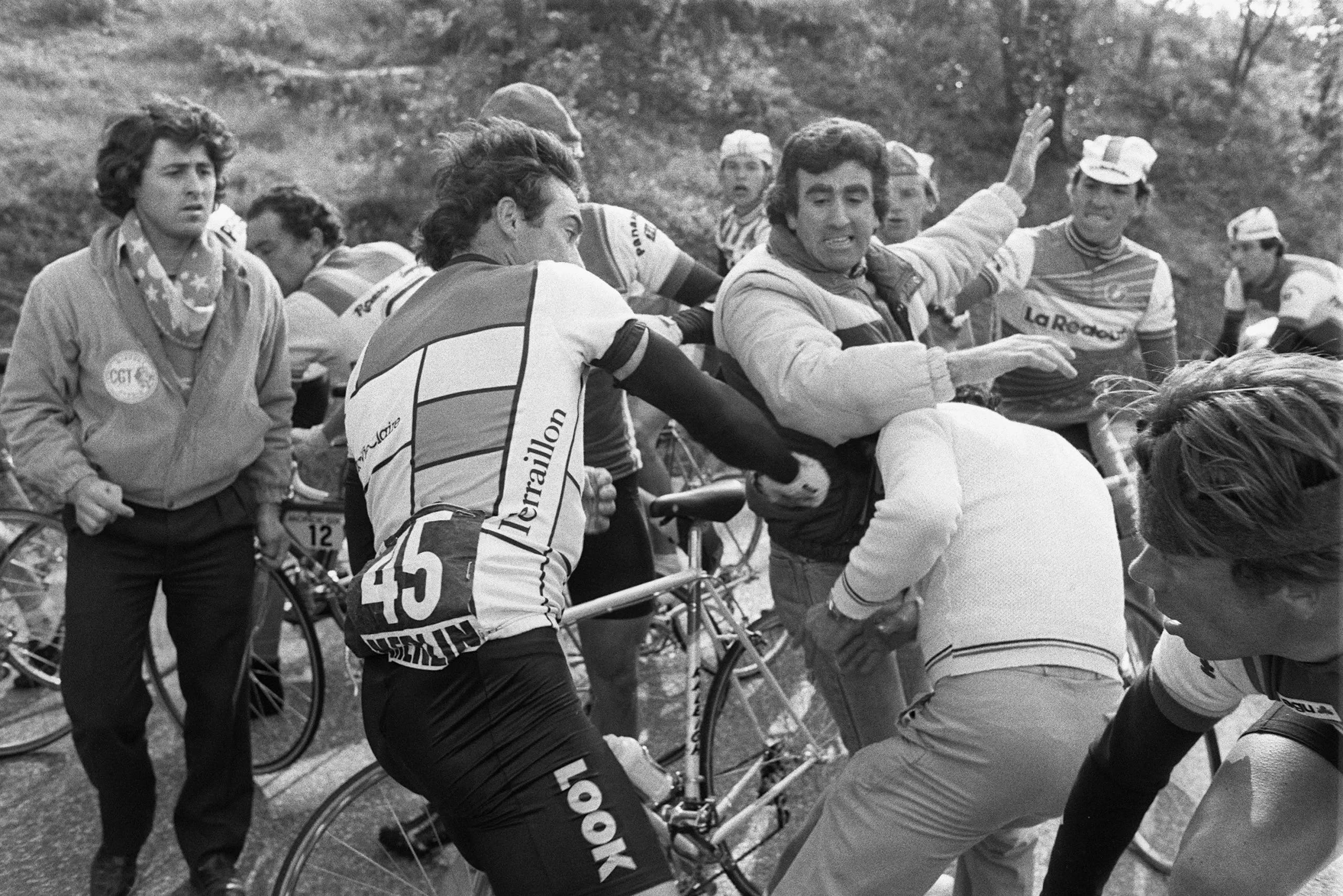
I was reminded, as I watched the Vuelta being affected on yet another day, by an instant of cycling history folklore that took place back in 1984, during the Paris-Nice race. Bernard Hinault (nicknamed The Badger for his aggressive nature and tenacity during his career) was possibly in his best position to finally win the race (one of few to elude him to that point). During a tricky decent from the Col de L’Espigoulier Hinault managed to lead a breakaway of about twenty riders, distancing the race leader, Robert Millar
As the riders were descending news reached them that there was a protest by dockworkers about massive restructuring with the inevitable mass redundancies and they were not happy. Hinault, a man whose motto was “As long as I breathe, I attack”, according to reports sailed into the melee of protesters, without even getting out of his cleats and straps and there is a memorable picture of Hinault, fist cocked, ready to pummel one of the dockworkers again, the photographers having missed the first punch. From his perspective it was a chance to win the race. He had distanced the leader, got a gap he felt confident he could retain and suddenly the road was blocked and the moment was gone. When the race got going again everyone in the race, including Millar were back together. Hinault never did win Paris-Nice.
I am not suggesting this course of action by cyclists now. Hinault was a one off. But he was a sporting immortal acting in a way he thought best to preserve the sport he loved so much. Even when retired from cycling and working for the Tour on the Podium, at the end of each days racing he would have no truck from protesters. He famously shoved a one off the podium at Stage three of The Tour de France in Nantes in 2003, straight into the arms of the waiting Gendarmes. He did it again with another podium interloper the following year. Sadly, Hinault is retired now. Who will be there to save the Tour the next time?
When you look through the roster of UCI teams, there seems to be some pretty rich pickings for potential protesters, not just Israel Premier Tech. I suppose it’s what we/they choose to care about.
There were sponsors of British cycling in recent history as controversial as Shell and before that HSBC and their inability to shake off an investigation into Mexican drug cartel money laundering. INEOS is a petrochemical company, who have cunningly changed the name of their cycling team to Ineos Grenadiers, which seems to have fooled the anti-fracking brigade.
BP had a long association with Peugeot, dating back to the 1960’s and a prominent sponsors logo was visible on Tom Simpsons world champions jersey.
Then we have Orica, who are an Australian multinational and one of the largest providers of commercial explosives, used in mining, quarrying, oil, gas and construction markets. Orica joined with Greenedge to form a team of that name, while it was reported that there had been chemical leaks of Ammonium Nitrate from a ship anchored off New South Wales, described by the maritime Union of Australia as ‘dangerously substandard’.
Even Donald Trump got involved in cycling for several years. In 1988 he created a cycling race across the North-East of America called……….yep, you’ve guessed it…’The Tour de Trump’. It only lasted for a couple of years, due to spiralling debts and the man’s business acumen.
Another one, again more recently was a Netherlands sponsor, who was one of the largest producers of Sex Toys. They bought the rights to a race that became the Easy Toys Bloeizone Fryslan Tour. There were more than a few eyebrows raised when they awarded the winner of the time trial, Ellen van Dijk with an X rated gift set. The female cyclist had the humour to declare that prizes in women’s cycling were improving. “That is, after all, one way to lube a chain…”
Finally, we get to Country sponsors. Those team sponsors, who are at the very forefront of the current best in cycling. UAE Team Emirates, Bahrain Victorious, Astana and Israel premier tech. All with allegedly questionable human rights records.
With so much to consider I suppose it is only natural that protesters will appear at major cycling events. As already stated, by the very nature of the events, they are such easy targets I fear that the organisers may just fold up the tents and call it a day!
I have had a look at the schedules. In a few day’s time Rwanda will host the World cycling championships in Kigali. The first time such an event has been held in Africa. I presume Israel will be sending a team. I also imagine that as the first African Nation to host such a prestigious event there will be a high level of security. But with the eyes of the world on them, how would they react to deliberate acts of sabotage or disruptions? Not one to dwell on, I feel.
Next year, after a heavily disrupted Vuelta in Spain this year and by unfathomable coincidence, the Tour de France starts in……? Barcelona…………..just saying!
As a cycling fan I can only hope that a way can be found to maintain road cycling as the spectacle it has become. It might mean more barriers, more police, greater distance (somehow) between the riders and the public and, as Brian Cookson suggests, removing country names from those teams that currently include them. All this needs some thought and discussion. But it needs it now.