
Reality Television
Is the gap between our Reality TV and Fictional dystopian game shows narrowing?

Today on the Block: Reality TV shows.
When did Reality Television start? It is hard to accurately say, but perhaps as long ago as the 1940’s when German television broadcasted a show in which a young couple acted as model Aryans, living their lives, without a script. It was Nazi propaganda of the time and still heavily censored. By the time the war ended other formats were being developed. In the USA for example, a program called Cash and Carry, set in a supermarket where contestants mainly answered questions stuck onto the side of a tin can but sometimes had to perform stunts with their partner and don’t forget the hidden camera show Candid Camera, with unsuspecting people reacting to pranks and jokes.
1964 in the UK, the Granada Television program Seven Up! filmed fourteen, seven year-olds from a range of different backgrounds and asked them about their lives. It was recommissioned every seven years with the same people, to see how the intervening period had gone for each of them. It’s still technically going today and to some degree turned the participants into celebrities.
The ‘Reality’ Television phenomenon was first part of my consciousness when Big Brother hit our screens way back in 2000. I never actively watched the show, but I became aware of it due to the intense broadcasting nature of the episodes. I think it was the inception of celebrity into the whole realm of Reality Television that began to pique my interest more.
When ‘I’m A Celebrity Get Me Out Of Here’ first aired in 2002 I began to see how television was creating a platform for celebrities of a ‘certain’ standing to be pitted against each other in a challenging environment. Looking back at the names of those taking part in that first series, they were all people who I had heard of. That maybe more of a statement about my age at that time and the people being of my televisual generation. Can you remember who triumphed in the end? I should make you look it up, but it was the British (for those reading outside of the UK) Radio DJ Tony Blackburn and he also did the most trials of any of his camp mates.
As this ratings winning idea began to take shape, the BBC brought their new revamped and sequinned show into the fray, with Strictly Come Dancing in 2004. They were reviving an old show and bringing it crashing into the 21st Century by bridging the generation gap (or game) with the fabulous Bruce Forsyth. A wonderful 1970’s all-round entertainer, who many may have thought had long passed the high point of his career. Then a memorable turn as guest presenter on Have I Got News for You in 2003 and suddenly his star was well and truly in the ascendancy. The BBC had the front man for their new celebrity vehicle and the show has never looked back.
It is easy as I write this, to get bogged down and actually disappear down a rabbit hole with the sheer weight of Reality shows out there now and all the sub-genres that exist within it. You have the documentary style, which includes soap opera (The Only way is Essex, or Made in Chelsea), professional style (Cops, Border Force), special living environments (Big Brother), courtroom (Judge Rinder), investment (Dragons Den), survival (think anything with Bear Grylls), self-improvement or make over (Trinny and Susannah Undress..), renovation (Changing Rooms), business improvement (Ramsay’s Kitchen Nightmares, The Apprentice), social experiment (Wife Swop), hidden camera (Candid Camera or Trigger-Happy TV)) and the supernatural (Ghost Hunters). ). I am sure the list goes on…
Then we get in the area that actually interests me. The Reality competition or the game show. This is where shows like Big Brother truly sit. The people in the Big Brother house are competing against each other to win a prize. They live together in a confined environment for a period of time and are then voted out. The watching audience can vote for their favourite or by disapproval of a contestant because of something they said, or their behaviour. The voting in this and other shows might include a combination vote between the viewers, a judging panel and even the contestants themselves.
To me, this is where the phenomenon becomes more primitive and interesting as a result, human nature is exposed at its most hostile and Machiavellian. So, what are these ‘contestants’ willing to endure in an effort to win the prize? And is the prize the only goal? By dint of the fact that they are on a television programme, beamed into millions of homes on a daily basis; they inevitably become familiar and those who are more successful can become celebrities themselves. Perhaps most likely to happen in the talent-based shows, like X Factor where contestants like, Leona Lewis, Alexandra Burke, Olly Murs, Little Mix and JLS all became household names.
Sometimes the money may be a secondary consideration, with the off spring of famous parents creating celebrity for themselves by appearing in Reality shows. I suppose examples like, Kelly Osbourne, Kim Kardashian (and the rest of them…), Paris Hilton and Nicole Ritchie spring to mind.
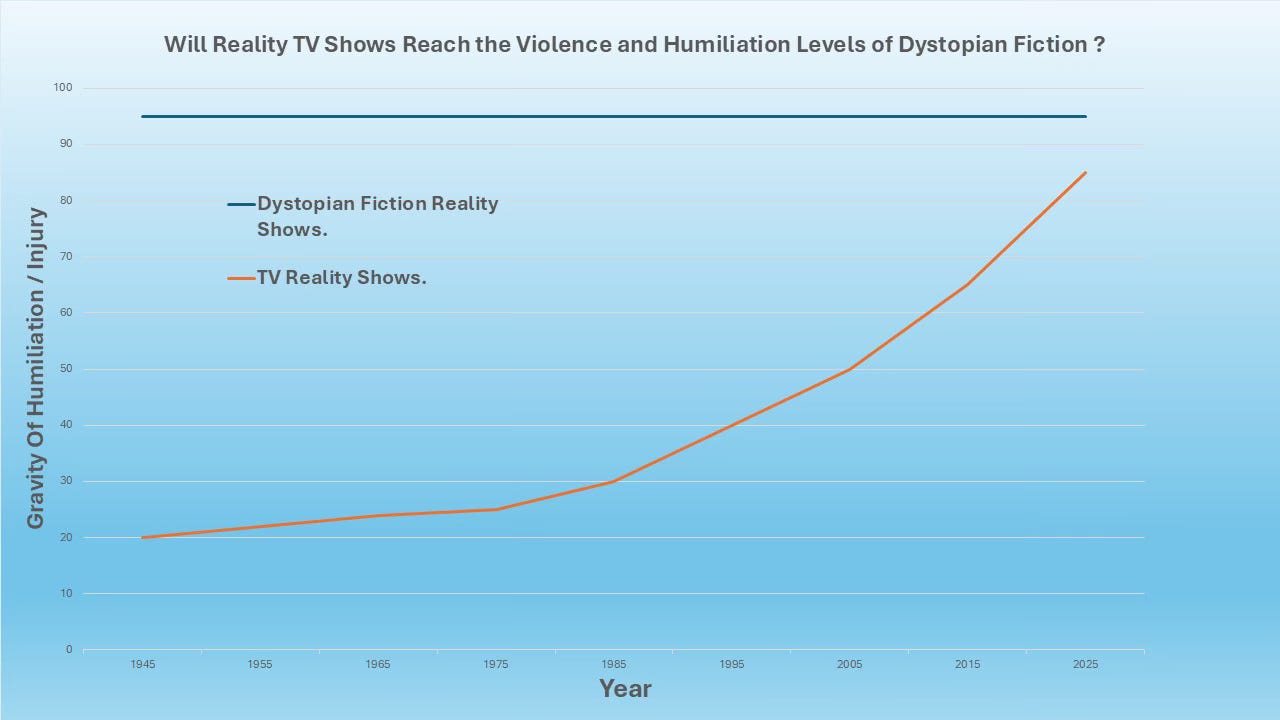
Going back to the question of just how far these ‘contestants’ are willing to go? Are we reaching a level of Reality programmes that are now so degrading, so humiliating and dangerous for those taking parts, that there is only really one place left for them to go? Is the viewing public ready to up the ante for that spectacle yet?
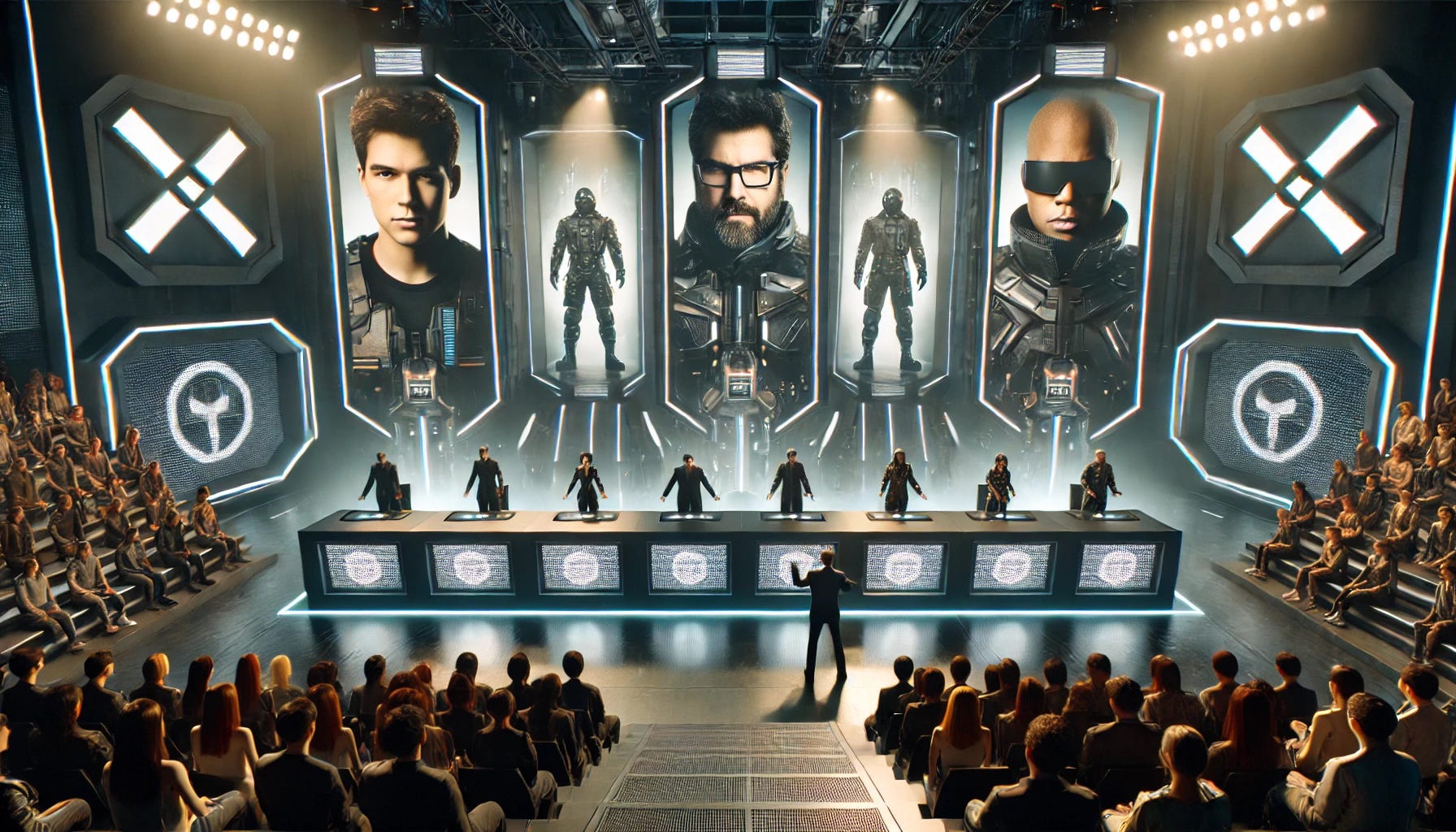
There has been so much fiction written about the ultimate game shows. Usually the authors set their pieces in a dystopian future. The game, challenge or tournament is ultimately set as a way to subjugate the weak, the poor and vulnerable. Of the numerous examples, I was most interested in the premise created by the 1982 novel, The Running Man, written by Richard Bachman. As it turned out, Bachman was a pseudonym for the writer Stephen King. When he was interviewed about the book he claimed that he wrote the piece in one week, rather than his more usual 2000 words a day output. That would mean his more usual writing pace would create a book in about three months (still pretty fast by my standards!). King added that he wrote the story as a young man, who was angry, energetic and just loved the craft of writing. He went on to say that the hero in his novel, Ben Richards, was a scrawny individual and about as far away from Arnold Schwarzenegger (who played Richards in the 1987 film version of the book) as you could get.
The book story of The Running Man is set in the future, at a time when the economy of the world is broken and America has become a totalitarian dystopia (that seems to be getting easier to imagine at the moment!). The tension builds as the character of Richards, desperately in need of money for his sick daughter’s medicine applies to The Games Network, to appear on one of its violent game shows. The Government controlled Network’s most dangerous show is The Running Man. Richards gets to appear and is given a twelve-hour head start before a team of the shows elite hunters are sent after him. He earns $100 for every hour he can stay alive and avoid capture, with additional money available for killing law enforcement officers and hunters. If he can survive for thirty days he wins the $1 Billion jackpot.
With the story of The Running Man still fresh in my mind, I sat down to watch a more recent ‘Reality show’ beamed across the world on Netflix, “Celebrity Bear Hunt”, with survival expert Bear Grylls. The headline for the programme…..
‘Holly Willoughby hosts this competition show set in the Costa Rican jungle, where twelve celebrities become prey for the ‘legendary’ survival expert, Bear Grylls”!
Who would they get to be subjected to such a ‘deadly’ challenge?
To my surprise they were almost all people I had heard of. A couple of perennial ‘Reality Show’ guests, doing the merry -go -round of all things Reality, but in the main, some fairly famous people. A few maybe saw it as a way to reignite the flame of a career on the wane, but others, I considered to be doing ok in the world of small screen celebrity.
How tough was this going to be then? At the start they were split up and told to make their way to a camp, while trying to avoid the seasoned ex-SAS hunter. In swings Bear, like some latter-day clothed Tarzan and despatches a few of them. No hang on! He doesn’t. Not a single garrotting, there was no sneaking up behind and grabbing the contestant before professionally slitting their throat. No, he just caught up with them, tapped them on the shoulder and tied their hands together. Uh! Bit of a let-down! Almost, “Touch, you’re it”!
Once in camp the twelve seemed to have plenty of food, alcohol, a comfortable space, even proper beds. At least on “SAS: Who Dares Wins” the celebs. are made to rough it a bit in camp and get regular ‘beastings’. This was beginning to feel completely soft and delicate.
It transpired that those caught would be the first up to try the Bear Pit (a confined area of parched open ground, trees, lakes and cliffs). They had to escape from the confined space or just evade the one-man army for an hour. The whole area was rigged with trip wires, traps and tools to aid escape. This will be it then. Someone is bound to fall in a pit with sharpened sticks at the bottom. Another is bound to spring a trap and be decimated by an anti-personnel mine. Nope, wrong again. The chosen victims just swanned about with foliage on their shoulders and some rudimentary camouflage cream on their faces. To be balanced about the show, some of them did get better as the week went on, but it was all still a bit tame.
I remarked to my wife, Paula, that I did think it might be more of a challenge for Bear if some of the ‘contestants’ had actually used a bit of initiative, sharpened sticks or killed the injured former tennis star! Maybe throw a few weapons out into the Bear Pit as well as the tools and stuff? The footage of a Spice Girl being impaled on a katana sword held by a Channel Four daytime presenter could have been Reality Television gold!
I actually thought the show had promise, but in our desire for still more extreme television the viewer, well certainly this viewer, wanted more. Some real jeopardy and genuine terror for their signing on fees please! The term “Reality TV Star” might just become a thing of the past, as they all gradually get wiped out…
As I contemplate the narrowing of the gap between the dystopian future described in The Running man, The Hunger Games or Battle Royale, I wonder just how long it will take for the Reality shows of today to meet the fictional Reality shows of tomorrow?
A new version of The Running Man is currently in production, due out towards the end of this year. It will more closely follow the plotline of the book.
Stephen King wrote his story about a society of the future in 1982. Do you know in what year his dystopian challenge is set?…….2025!
Fascinating post, Guy, and I can’t help but wonder: maybe dystopian fiction didn’t predict the future, it just didn’t go far enough. Reality TV seems to expose a truth even more uncomfortable, not a fall from grace, but a slow, willing descent. Less “Big Brother is watching” and more “we’re auditioning to be watched.”
Makes me think: has human nature actually changed, or have we just designed platforms that let it strut around unfiltered? Maybe our craving for risk, drama, and exposure was always there, just waiting for producers and a prime-time slot.
What’s more dystopian: being forced into a system, or volunteering for it?
Siggy xx
Raised by Shrinks
Brilliant piece Guy - I began reading and was just about to bemoan the absence of "The Running Man" - when you went all in! I love a documentary, less keen on reality TV per se. Keep up the great work!